
Central Auditory Processing Disorder (CAPD)
What is Central Auditor Processing Disorder (CAPD)?
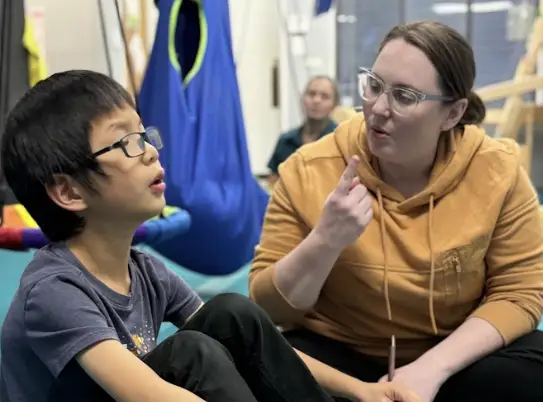
Symptoms often become more noticeable once children begin preschool or elementary school, when listening demands increase.
Difficulty Following Directions
Children may:
- Frequently ask people to repeat themselves.
- Need directions repeated multiple times.
- Miss parts of multi-step instructions.
- Forget what was just said.
Example: “Go hang up your backpack, wash your hands, and sit at the table.”
A child with CAPD may only complete the first step.
Trouble Understanding Speech in Noisy Places
Many children struggle to:
- Listen in classrooms
- Hear teachers over background chatter
- Understand conversations in restaurants
- Follow discussions during group activities
Background noise can make speech sound “jumbled.”
Frequently Saying “What?”
Children may often say:
- “Huh?”
- “Can you say that again?”
- “What did you say?”
This happens even though they can physically hear the speaker.
Difficulty Remembering Verbal Information
Children may struggle to remember:
- Lists
- Classroom instructions
- Stories read aloud
- Verbal homework assignments
Poor Listening Skills
Parents and teachers may think the child is:
- Not paying attention
- Ignoring adults
- Daydreaming
- Easily distracted
In reality, the child may be working very hard to process spoken language.
Academic Challenges
CAPD can affect:
- Reading comprehension
- Spelling
- Vocabulary development
- Following classroom discussions
- Taking notes
- Learning through verbal instruction
Children often perform better when information is presented visually.
Difficulty Distinguishing Similar Sounds
Children may confuse words like:
- fifteen/fifty
- cat/cap
- ship/chip
- pen/pin
This can impact speech, reading, and spelling.
Trouble Understanding Rapid Speech
If someone speaks quickly, the child may miss key words and struggle to understand the full message.
Challenges with Phonological Awareness
Children may have difficulty:
- Rhyming
- Identifying beginning sounds
- Breaking words into syllables
- Blending sounds together
These skills are essential for learning to read.
Fatigue After School
Listening requires significantly more effort for children with CAPD.
Many children:
- Come home exhausted
- Become irritable
- Avoid conversations
- Need quiet time after school
What Causes CAPD?
CAPD can occur:
- On its own
- Alongside language disorders
- After repeated ear infections
- Following traumatic brain injury
- In children born prematurely
- With certain neurological conditions
Sometimes, the exact cause is unknown.
How Is CAPD Diagnosed?
CAPD cannot be diagnosed by a speech-language pathologist alone.
A comprehensive evaluation typically includes:
- A hearing evaluation to confirm normal hearing.
- Specialized auditory processing testing completed by a pediatric audiologist (typically for children age 7 and older, when testing is more reliable).
- Speech-language evaluation.
- Review of academic performance.
- Parent and teacher input.
Because CAPD symptoms overlap with ADHD, language disorders, dyslexia, and learning disabilities, a thorough evaluation helps identify the underlying cause.

How Therapy Smarts Supports Children with CAPD
While a diagnosis of Central Auditor Processing Disorder (CAPD) comes with unique challenges, it also comes with incredible potential. At Therapy Smarts, our multidisciplinary team in Durham and Chapel Hill works together to create a customized “roadmap” that helps your child hit their milestones and gain independence.
Because every child is unique, therapy is individualized based on their strengths, goals, and medical needs.
Although CAPD itself is diagnosed by an audiologist, Therapy Smarts’ speech-language pathologists can help children strengthen the language and listening skills that are often affected by CAPD.
Children may benefit from therapy that targets:
Listening Comprehension
Therapists help children:
- Improve understanding of spoken language
- Follow multi-step directions
- Recall verbal information
- Process increasingly complex instructions
Language Development
Speech-language therapy focuses on:
- Vocabulary
- Sentence comprehension
- Verbal reasoning
- Story sequencing
- Conversational skills
Auditory Memory
Children practice remembering:
- Numbers
- Words
- Sentences
- Classroom information
- Directions
Improved auditory memory supports success both at school and at home.
Phonological Awareness
Therapists work on:
- Rhyming
- Sound discrimination
- Segmenting words
- Blending sounds
- Reading readiness skills
These skills support literacy development.
Listening Strategies
Children learn practical strategies, including:
- Looking at the speaker
- Asking for clarification
- Repeating directions aloud
- Breaking information into smaller parts
- Using visual supports and written reminders
Executive Function Skills
Therapy may also address:
- Organization
- Attention
- Planning
- Working memory
- Self-advocacy
These skills help children manage classroom demands more effectively.
Collaboration with Families and Schools
Therapy Smarts partners with parents and educators to develop strategies that support children across environments. Recommendations may include:
- Reducing background noise during learning
- Providing written directions alongside verbal instructions
- Breaking tasks into smaller steps
- Checking for understanding before moving on
- Allowing extra processing time before expecting a response
Wondering About Developmental Milestones?
Have questions about your child’s development, or wondering if a certain diagnosis may be a fit? Try out our developmental screening tool— it’s a fast, free way to get a snapshot of your child’s progress on his or her developmental milestones.
Ready to Help Your Child Reach Their Full Potential?
At Therapy Smarts, we don’t believe in a “wait and see” approach. We believe in early, expert intervention that gives your child the tools they need to thrive. Whether you are looking for specialized Down Syndrome support or a comprehensive developmental evaluation, our award-winning team in Durham and Chapel Hill is ready to partner with your family.
Two Easy Ways to Begin:
Contact Us Directly: Ready to schedule? Call us at 919-378-1340.
Fill out our Online Inquiry Form to speak with a member of our intake team.
Don’t navigate this journey alone—let’s unlock your child’s possibilities together