

Written by the Therapy Smarts Occupational Therapy and Mental Health teams · Reviewed by : Delia Boyer, Mental the Health Director · Last reviewed October 2026
A seven-year-old who cannot sit through dinner, melts down over a scratchy shirt, refuses to go to school and “never listens” could have ADHD. Or sensory processing disorder. Or anxiety. Or two of the three. From the outside the behaviors look the same, and that is exactly why so many children get the wrong label first.
The short answer: ADHD is about regulating attention and impulses; sensory processing disorder (SPD) is about how the brain handles sensory input; anxiety is about worry and the body’s threat response. The way to tell them apart is not the behavior itself, but when it happens, what triggers it and what makes it stop. Here is how our pediatric occupational therapists and child mental health clinicians in Durham and Chapel Hill work through it, and how you can start at home.
Key takeaways
- The same behaviors (meltdowns, not listening, can’t sit still, avoiding activities) show up in all three. Look at the pattern, not the behavior.
- ADHD shows up everywhere, all the time, and is not fixed by changing the environment. SPD follows sensory input and often disappears when the input changes. Anxiety follows worry and is relieved by escape or reassurance.
- They frequently overlap. Many children with ADHD also have sensory differences or anxiety, so “which one” can be “more than one.”
- SPD is evaluated by a pediatric occupational therapist. ADHD and anxiety are evaluated by a psychologist or physician. Therapy Smarts offers both evaluations under one roof.
Why these three get confused
All three conditions affect the same thing a parent or teacher can actually see: a child’s ability to stay regulated, follow directions and participate. A child who is overwhelmed by noise, a child who cannot hold attention, and a child who is frightened of making a mistake can all end up crying under the table during a math lesson.
They also overlap biologically. Research consistently finds that children with ADHD are more likely than other children to have sensory processing differences and anxiety, and children with anxiety often struggle with attention because a worried brain has less room to focus. So the question is rarely “which one is it?” and more often “which one is driving this behavior, right now?”
ADHD in children: what it actually looks like
Attention-deficit/hyperactivity disorder is a neurodevelopmental difference in how the brain manages attention, impulse control and activity level. The hallmark is that the difficulty is persistent and present across settings (home, school, grandma’s house, the playground), and that it started early, typically before age 12.
Common signs:
- Loses focus even on things they enjoy, not just on homework
- Starts tasks and abandons them; forgets instructions halfway through
- Fidgets, climbs, talks constantly, interrupts, cannot wait a turn
- Acts before thinking, then is genuinely surprised by the consequence
- Behavior is the same whether the room is quiet or loud, calm or busy
The tell: changing the environment helps only a little. A child with ADHD struggles in the quiet library and the noisy cafeteria.
Sensory processing disorder: what it actually looks like
Sensory processing disorder describes a brain that registers or organizes sensory information differently, so everyday input feels too intense, too faint, or confusing. Some children are over-responsive (tags, seams, loud hand dryers and bright lights are genuinely painful), some are under-responsive (they do not notice their name, a wet shirt or a scraped knee), and some are sensory seekers (they crash, spin, chew, squeeze and bump into everything to get the input they need). Many children are a mix.
Common signs:
- Meltdowns that are clearly tied to a sensory trigger: a haircut, a fire drill, a crowded birthday party, a new food texture
- Covers ears, avoids messy play, gags at smells, hates tooth-brushing or hair-washing
- Seems “not to listen” when the room is noisy but hears fine one-on-one
- Constant movement that calms the child rather than winding them up
- Extreme picky eating, clothing battles, trouble with transitions between activities
The tell: the behavior follows the input. Remove the trigger (quiet room, seamless socks, a weighted lap pad) and the child often re-regulates within minutes.
SPD is not a formal diagnosis in the DSM-5, the manual physicians use, which is one reason it is under-identified. It is assessed and treated by pediatric occupational therapists using standardized sensory evaluations.

Anxiety in children: what it actually looks like
Anxiety is the body’s threat system switching on when there is no real danger. In children it rarely looks like an adult saying “I’m worried.” It looks like behavior.
Common signs:
- Avoidance: refuses school, sleepovers, sports, or new activities, often with a stomachache or headache that is real
- Lots of questions and reassurance-seeking (“Are you sure?”, “What if?”)
- Perfectionism, erasing holes in the paper, tearing up work that is “wrong”
- Irritability, anger or meltdowns that come before a feared event rather than during sensory overload
- Trouble sleeping, clinginess, big reactions to small changes in routine
- “Not paying attention” because the child is mentally rehearsing what could go wrong
The tell: the behavior follows the worry. It spikes before the feared thing and drops as soon as the child is allowed to escape it or is reassured.
Side-by-side: the same behavior, three different causes
| What you see | If it’s ADHD | If it’s sensory (SPD) | If it’s anxiety |
|---|---|---|---|
| Can’t sit still | Everywhere, all day; movement does not calm them | Movement calms them; worse in under-stimulating or overwhelming spaces | Restless before specific events; settles once the event passes |
| Meltdowns | Triggered by frustration, waiting, being told no | Triggered by sound, touch, texture, crowds, transitions | Triggered by separation, new situations, fear of failure |
| “Doesn’t listen” | Attention drifts even in quiet, one-on-one | Hears fine in quiet; misses instructions in noisy rooms | Listening fine, but frozen or distracted by worry |
| Avoids homework or activities | Can’t sustain effort; starts and quits | Avoids specific textures, noises or physical demands | Avoids anything with a chance of being judged or wrong |
| Trouble sleeping | Can’t wind down; busy body | Bothered by pajama seams, sheets, sounds, light | Lies awake worrying; needs a parent in the room |
| Picky eating or clothing battles | Impatience, not sensitivity | Strong, consistent reactions to specific textures, temperatures or tags | Fear of choking, vomiting or getting sick |
| Impulsive or aggressive | Acts before thinking; remorseful right after | Lashes out when overloaded; often “fight” after sensory overload | Lashes out when cornered into a feared situation |
| Does it change with the environment? | Only a little | Dramatically | Dramatically, but based on perceived safety, not sensory load |
Not sure which column your child fits? That is normal, and it is exactly what an evaluation is for. Call (919) 378-1340 and we will help you decide which evaluation to start with.
Five questions that help you sort it out at home
Keep a simple log for two weeks. For each tough moment, write down:
- When did it happen? Time of day, before or after what. Anxiety clusters before feared events; sensory overload clusters in loud, busy, or transition-heavy moments; ADHD is spread evenly.
- Where were you? Does it happen in quiet rooms and one-on-one? That points away from sensory and toward ADHD or anxiety.
- What was the trigger? A sound, texture or crowd (sensory), a demand or a wait (ADHD), or a fear of what might happen (anxiety).
- What made it stop? Removing the input, leaving the situation, or simply time passing each point in a different direction.
- Does it happen when your child is doing something they love? ADHD-related attention problems still show up during preferred activities. Anxiety and sensory issues often vanish there.
Bring the log to the evaluation. It is the most useful thing a parent can hand a clinician.
When it is more than one
A large share of the children we see have overlapping profiles: ADHD with sensory seeking, anxiety that developed after years of sensory overload at school, or ADHD plus anxiety about always being “in trouble.” Treating only one piece often leaves a child still struggling. That is why we evaluate across disciplines rather than guessing from a single checklist.
If you already have an ADHD diagnosis and your child is still having meltdowns that medication or behavior plans do not touch, a sensory evaluation is a reasonable next step. If sensory strategies have helped at home but your child still refuses school, it is time to look at anxiety.
How evaluation works
Different professionals evaluate each condition:
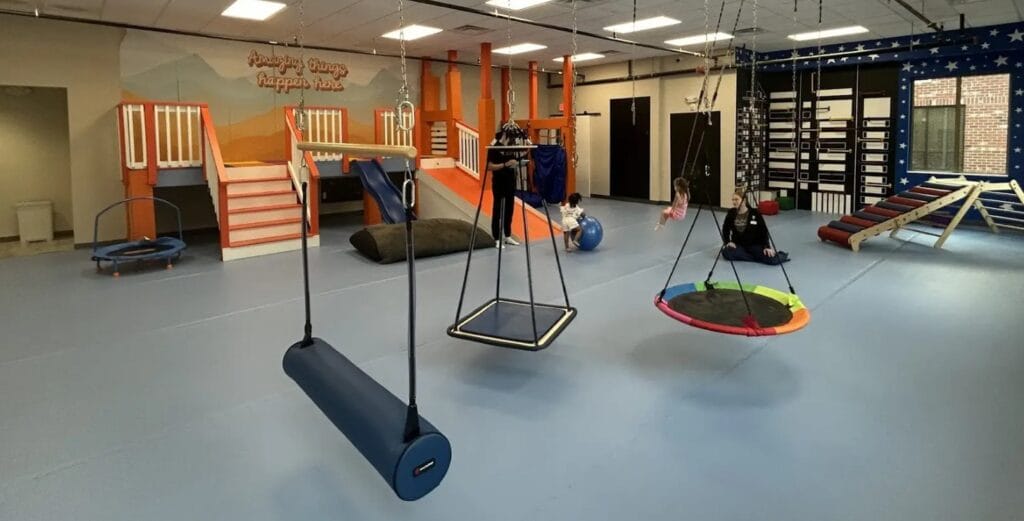
- Sensory processing is evaluated by a pediatric occupational therapist using standardized sensory profiles, clinical observation and parent and teacher input. Our OT team does this in our sensory gyms in Durham and Chapel Hill.
- ADHD and anxiety are evaluated by a psychologist (or your pediatrician for ADHD). Our mental health team offers psychological evaluations that look at attention, mood, anxiety and learning together, so one appointment can sort out all three.
- Your pediatrician is always part of the picture and can rule out medical causes such as hearing or vision problems, sleep issues or thyroid concerns.
If your child is under six and you are unsure where development stands overall, start with our free developmental checklist.
What helps
- For sensory processing: occupational therapy builds a child’s ability to regulate, using play in a sensory gym and a “sensory diet” of activities you can do at home and school. Simple changes (seamless clothing, noise-reducing headphones, movement breaks) often bring fast relief.
- For anxiety: child and family therapy using cognitive-behavioral strategies teaches kids to notice worry and face feared situations step by step. For younger children, Parent-Child Interaction Therapy (PCIT) and parent coaching are highly effective.
- For ADHD: behavioral strategies, executive-functioning coaching and parent training come first, and occupational therapy helps with the organization and emotional regulation pieces. Some children also benefit from medication, which is prescribed and managed by your pediatrician or a psychiatrist; Therapy Smarts does not prescribe.
Whatever the cause, parents are part of the treatment team. We coach you on what to do in the moment and share strategies with your child’s teachers so the plan works everywhere.
What to do this week
- Start the two-week log using the five questions above.
- Read our guide to behavioral vs. sensory issues for ten everyday examples.
- Talk to your pediatrician and share the log.
- Call us at (919) 378-1340 or request an evaluation. Tell us what you are seeing; we will recommend whether to start with an OT sensory evaluation, a psychological evaluation, or both.
Frequently asked questions
How do I know if my child has ADHD or sensory processing disorder?
Look at the pattern. ADHD difficulties show up across all settings and do not improve much when the environment changes. Sensory processing difficulties are tied to specific input (noise, touch, textures, crowds) and usually ease quickly when the input is removed. An OT sensory evaluation and a psychological evaluation can sort it out, and Therapy Smarts offers both.
Can anxiety look like ADHD in children?
Yes. A worried child can seem inattentive, restless, irritable and forgetful because their attention is consumed by worry. The difference is that anxiety-related inattention spikes around feared situations and eases with reassurance, while ADHD-related inattention is constant.
Can a child have ADHD and sensory processing disorder at the same time?
Yes. Overlap is common, and many children with ADHD also have sensory differences, anxiety, or both. That is why evaluating across disciplines matters.
Who diagnoses sensory processing disorder?
A pediatric occupational therapist evaluates sensory processing using standardized assessments and clinical observation. SPD is not listed in the DSM-5, so it is identified through an OT evaluation rather than a medical diagnosis.
What kind of evaluation does my child need first?
If meltdowns clearly follow sensory triggers, start with an OT sensory evaluation. If the main concerns are attention, impulsivity, worry or avoidance, start with a psychological evaluation. If you are not sure, call us and we will help you decide.
Is a sensory meltdown the same as a tantrum?
No. A tantrum is goal-directed (the child wants something and stops when they get it or realize they will not). A sensory meltdown is a nervous-system overload that the child cannot stop on command and that passes only when the input is reduced and the child re-regulates.
Not sure where to start?
Therapy Smarts is one of the few pediatric practices in the Triangle with occupational therapists and child mental health clinicians in the same clinics, so your child’s sensory, attention and anxiety needs can be evaluated together. Call (919) 378-1340 or request an evaluation at our Durham or Chapel Hill clinic. Most insurances and NC Medicaid are accepted.
This article is for general information and is not a substitute for an evaluation by a licensed professional.
Further reading: CDC: What is ADHD? · AAP HealthyChildren.org: Sensory Integration · STAR Institute for Sensory Processing · NIMH: Anxiety Disorders