If you have searched “pediatric OT near me” after another difficult morning, you are probably not looking for a definition of occupational therapy. You are trying to make sense of something you see every day.
Maybe getting dressed turns into a long negotiation because socks, seams, or shirt tags feel unbearable. Maybe your child avoids crayons and scissors while other kids seem happy to sit and create. Maybe they are always on the move, bumping into furniture, crashing into couch cushions, or melting down after a busy day at preschool.
Sometimes the concern is easier to name. Handwriting is hard. Shoes are hard. Meals are hard. Bedtime is hard. School drop-off is hard.
Pediatric occupational therapy can help families understand what is behind those struggles and find practical ways to make daily life feel less frustrating.
At Therapy Smarts, we provide pediatric occupational therapy for children and teens throughout the Triangle. Families visit us from Durham, Chapel Hill, Raleigh, Cary, Apex, Morrisville, Carrboro, Hillsborough, and nearby communities.
What Pediatric Occupational Therapy Actually Helps With
For kids, “occupations” are the things that fill their day: getting ready, eating, playing, learning, moving, making friends, and settling down for sleep.
Pediatric OT focuses on helping children take part in those everyday activities with more comfort, skill, and independence. The work may involve fine-motor skills, sensory needs, coordination, body awareness, attention, emotional regulation, self-care, or play.
That can sound like a lot, but it usually starts with one simple question:
What parts of your child’s day are harder than they need to be?
For one family, the answer might be mornings. Their child needs help getting dressed but cannot tolerate certain fabrics, gets upset when shoes feel “wrong,” and becomes overwhelmed before they even leave the house.
For another family, it may be school. Their child understands the lesson but struggles to keep up with writing, cutting, organizing supplies, or sitting through a task that requires a lot of focus.
For someone else, it is the grocery store, the playground, the dinner table, or bath time.
An occupational therapist looks at the whole routine—not just the one behavior that brought you in.
“Is This Something OT Can Help With?”
Parents often wait to call because they are unsure whether their concern is “big enough.” You do not need a perfect explanation, and you do not need to already know what kind of help your child needs.
It may be worth talking with a pediatric OT if your child:
- Avoids handwriting, coloring, crafts, buttons, zippers, or using utensils
- Has trouble with shoes, socks, hair brushing, teeth brushing, nail trimming, or baths
- Gets overwhelmed by loud places, busy rooms, clothing textures, smells, or food textures
- Seeks lots of movement, such as spinning, jumping, crashing, chewing, or climbing
- Has frequent meltdowns around transitions or everyday routines
- Seems uncoordinated, falls often, or has trouble learning new movement skills
- Needs a lot of help with dressing, grooming, eating, toileting, or packing for school
- Has difficulty sitting for meals, schoolwork, or other activities that matter to them
- Becomes discouraged when tasks require several steps
- Struggles to join peer play or keep up with daily school expectations
A child may have a diagnosis such as autism, ADHD, developmental delay, anxiety, or a learning difference. They may also have no diagnosis at all. Either way, the reason for seeking OT is often the same: a daily task is getting in the way of a child’s comfort, confidence, or ability to participate.
It Is Not About “Fixing” Your Child
This matters. Good pediatric occupational therapy should not be about forcing a child to act like everyone else or pushing them through situations that overwhelm them.
Children have different sensory preferences, energy levels, interests, communication styles, and ways of moving through the world. OT can help identify what a child needs to feel regulated and successful while building skills for the things they want or need to do.
For example, if a child finds hair washing upsetting, the goal is not simply to make them tolerate it without complaint. The therapist may help the family understand what is difficult about the experience and experiment with strategies that make the routine more manageable.
That could mean adjusting the water temperature, changing the order of steps, using a washcloth instead of direct water, giving the child more control, adding a visual routine, or practicing slowly over time.
The best solutions are usually the ones a family can actually use on a Tuesday night when everyone is tired.
What Happens at a Pediatric OT Evaluation?
The first appointment is a chance to put the pieces together. Parents often arrive with a mental list of things that have been hard for months—or years.
The occupational therapist will ask about your child’s development, medical history, school experience, daily routines, interests, sensory preferences, and the situations that are causing the most stress. They may watch your child play, draw, move, build, use their hands, or complete activities that provide information about coordination, fine-motor skills, sensory processing, attention, and motor planning.
Your child does not need to perform perfectly. In fact, how they approach an activity can be just as helpful as whether they complete it.
The therapist may notice things such as:
- Does your child avoid certain textures or types of movement?
- Do they use too much or too little force when writing, playing, or handling objects?
- Is it hard to coordinate both hands during tasks?
- Do they have trouble planning how to start an unfamiliar movement or activity?
- Do they become frustrated quickly when a task is challenging?
- Are there parts of a routine that demand more energy from them than parents realize?
After the evaluation, you should leave with clearer information—not more jargon. Your therapist should explain what they observed, what may be contributing to the challenge, and whether OT is recommended.
What Pediatric OT Sessions Look Like
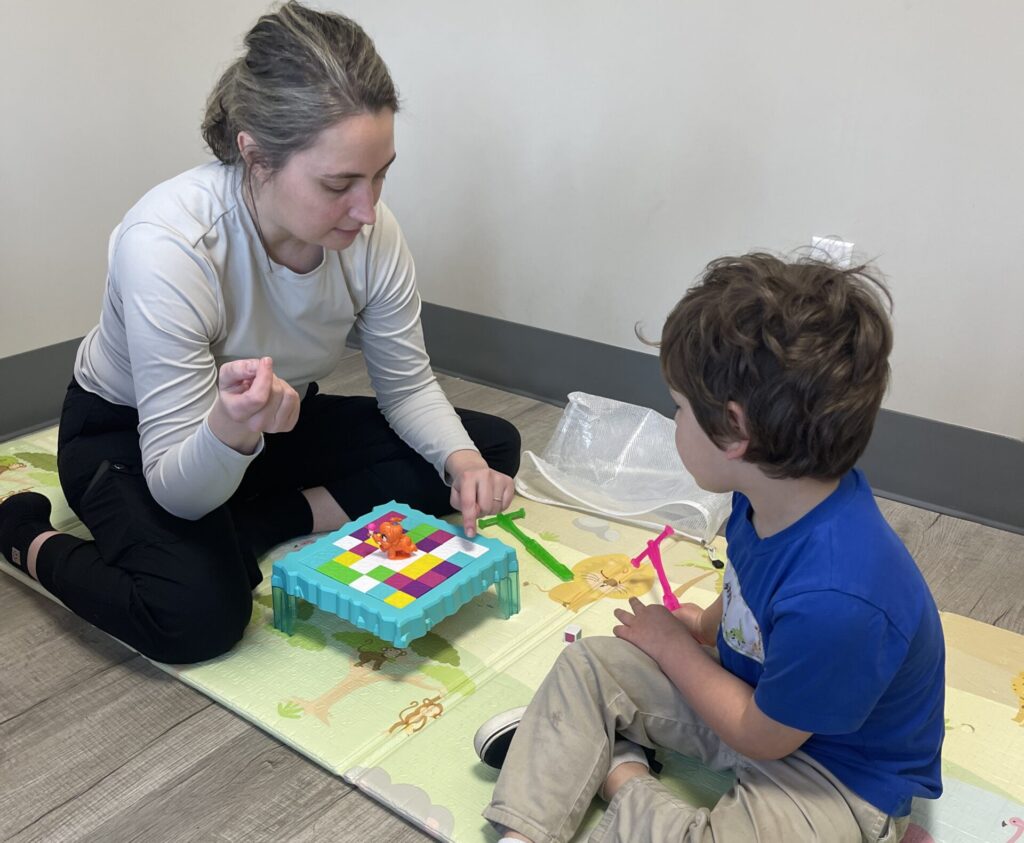
Parents sometimes picture OT as worksheets at a small table. There may be table work at times, especially for handwriting or fine-motor goals, but most pediatric OT looks much more like purposeful play.
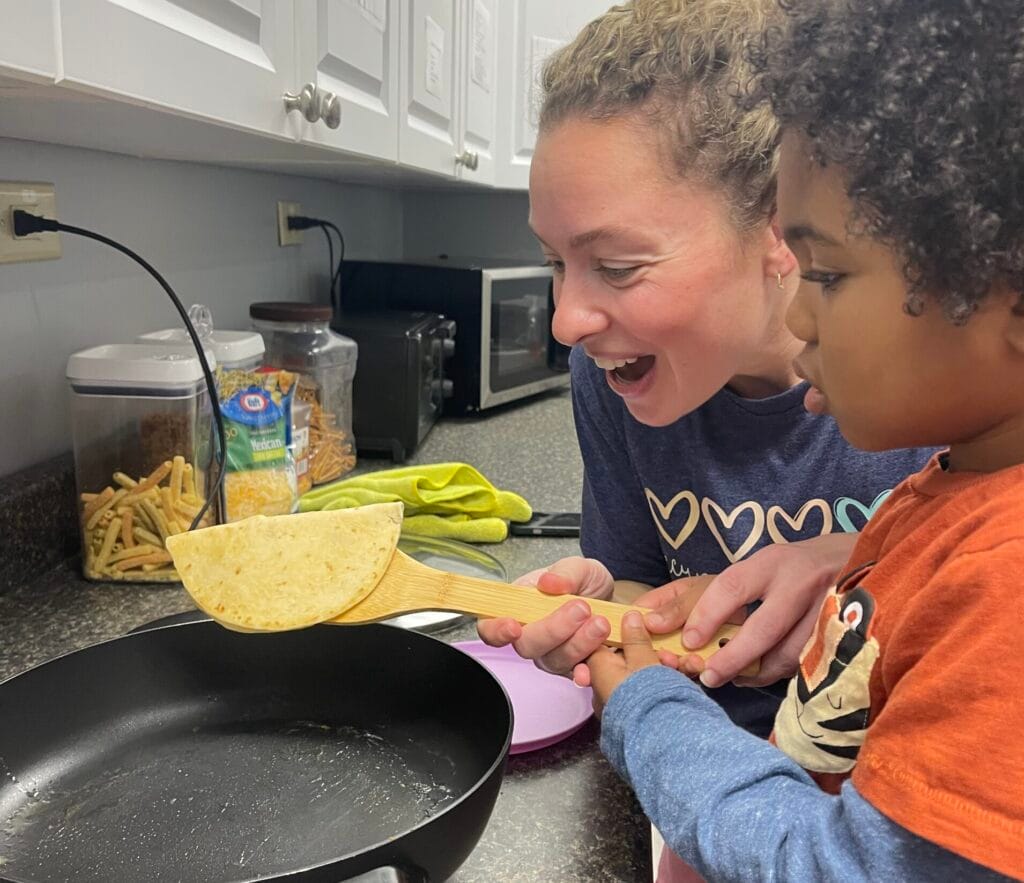
A session may include an obstacle course, a building challenge, a craft, a game, pretend play, movement activities, a cooking task, or practice with a real-life skill. The activity is chosen because it gives the child a chance to work on something meaningful.
A child working on hand strength and coordination might use play dough, tongs, clothespins, puzzles, or building toys. A child who struggles with movement planning may work through a course that involves crawling, climbing, balancing, and following steps in order. A child who finds transitions difficult may practice visual schedules, flexible thinking, and calming tools through games and routines.
The activity may look simple. The therapist is paying attention to much more than the finished product.
They are noticing how the child moves, responds, solves problems, uses their hands, handles frustration, takes breaks, and asks for help.
Sensory Needs Are Often Part of the Story
Sensory concerns are one of the most common reasons parents begin looking for OT for kids near them.
You may have a child who cannot stand certain clothes but wants to wear the same soft shirt every day. You may have a child who covers their ears in public bathrooms, avoids birthday parties, refuses most foods, or gets upset in crowded stores. Or your child may seem to need constant movement and struggle to settle their body for schoolwork, meals, or bedtime.
Sensory input affects all of us. Some people dislike scratchy fabrics. Others are bothered by strong perfume or a noisy restaurant. For some children, though, those sensations are more intense and can make everyday environments feel exhausting or unpredictable.
Pediatric occupational therapy can help families better understand their child’s sensory patterns. It may also offer realistic strategies for home, school, and community settings.
That might include planning a movement break before homework, keeping headphones in the car for noisy places, choosing clothing that feels comfortable, preparing a child for a new environment, or creating a calmer bedtime routine.
The goal is not to eliminate every hard sensation. It is to help children feel supported enough to participate in their lives.
OT Can Support More Than Handwriting
Handwriting is a common reason for referral, but it is only one piece of pediatric occupational therapy.
A child who writes slowly or avoids written work may need support with hand strength, grasp, posture, visual-motor coordination, endurance, or confidence. They may also be using so much effort to keep their body organized that there is little energy left for the assignment itself.
The same idea applies to other tasks. A child who has trouble getting dressed may not just be “being stubborn.” They may be struggling with motor planning, sensory discomfort, coordination, sequencing, or the pressure of a rushed morning.
Looking beneath the surface can change the way a family responds. Instead of repeating, “Come on, you know how to do this,” a parent may learn how to break the task into smaller steps, offer the right kind of support, and build independence over time.
How Parents Are Included
Pediatric OT should not happen in a bubble. The most important parts of a child’s life are not inside a therapy room. They are at home, at school, on the playground, in the car, at grandparents’ houses, and in the middle of ordinary family routines.
Parents and caregivers bring the context that makes therapy useful. They know what the difficult moments look like, what has already been tried, what their child enjoys, and what a successful day would actually mean for the family.
At Therapy Smarts, the goal is to make therapy recommendations practical. A strategy that only works in a clinic is not enough. Families need ideas they can use during school mornings, mealtimes, errands, homework, and bedtime.
Sometimes that means a new tool or routine. Sometimes it means changing the environment. Sometimes it means giving a child more time, more choices, or a better way to communicate what they need.
When More Than One Service Helps
Children are complex, and their needs may overlap. A child who has difficulty with sensory regulation may also have feeding challenges. A child who struggles with fine-motor tasks may also need help with speech and language. A child with balance or coordination concerns may benefit from both OT and pediatric physical therapy.
Therapy Smarts offers several pediatric services, making it easier for families to access coordinated care when it is recommended. In addition to occupational therapy for children, families may explore speech therapy, feeding therapy, ABA therapy, pediatric mental health services, or psychological evaluations.
Not every child needs multiple services. But when they do, communication between providers can help everyone stay focused on the same real-life goals.
Choosing a Pediatric OT in Durham, Chapel Hill, or Raleigh
“Near me” matters, especially when you are fitting therapy into an already full week. But proximity is only part of the decision.
As you look for pediatric occupational therapy in the Triangle, consider whether the provider:
- Works primarily with children and understands child development
- Listens to your concerns without brushing them aside
- Explains things in plain language
- Includes parents in goals and treatment planning
- Uses a child-centered, respectful approach
- Has experience with the concerns bringing you in
- Offers a comfortable environment for children with sensory or developmental differences
- Can coordinate with other professionals when needed
Therapy Smarts serves Triangle families from clinics in Durham and Chapel Hill. Our pediatric OT team works with children and adolescents on the skills that shape everyday participation—from getting dressed and holding a pencil to handling sensory challenges and building confidence in school and play.
Looking for Pediatric OT Near You?
If you are in Raleigh, Durham, Chapel Hill, Cary, Apex, Morrisville, Carrboro, Hillsborough, or another Triangle community, Therapy Smarts can help you explore whether pediatric occupational therapy is a good next step.
You do not need to arrive with the right label for what is going on. Start with the routine that feels hardest right now. A conversation and evaluation can give you a clearer understanding of your child’s needs and practical options for support.
Learn more about pediatric occupational therapy at Therapy Smarts, or call 919-378-1340 to ask about scheduling an evaluation at our Durham or Chapel Hill clinic. Therapy Smarts provides pediatric OT and related therapy services for children across the Triangle.