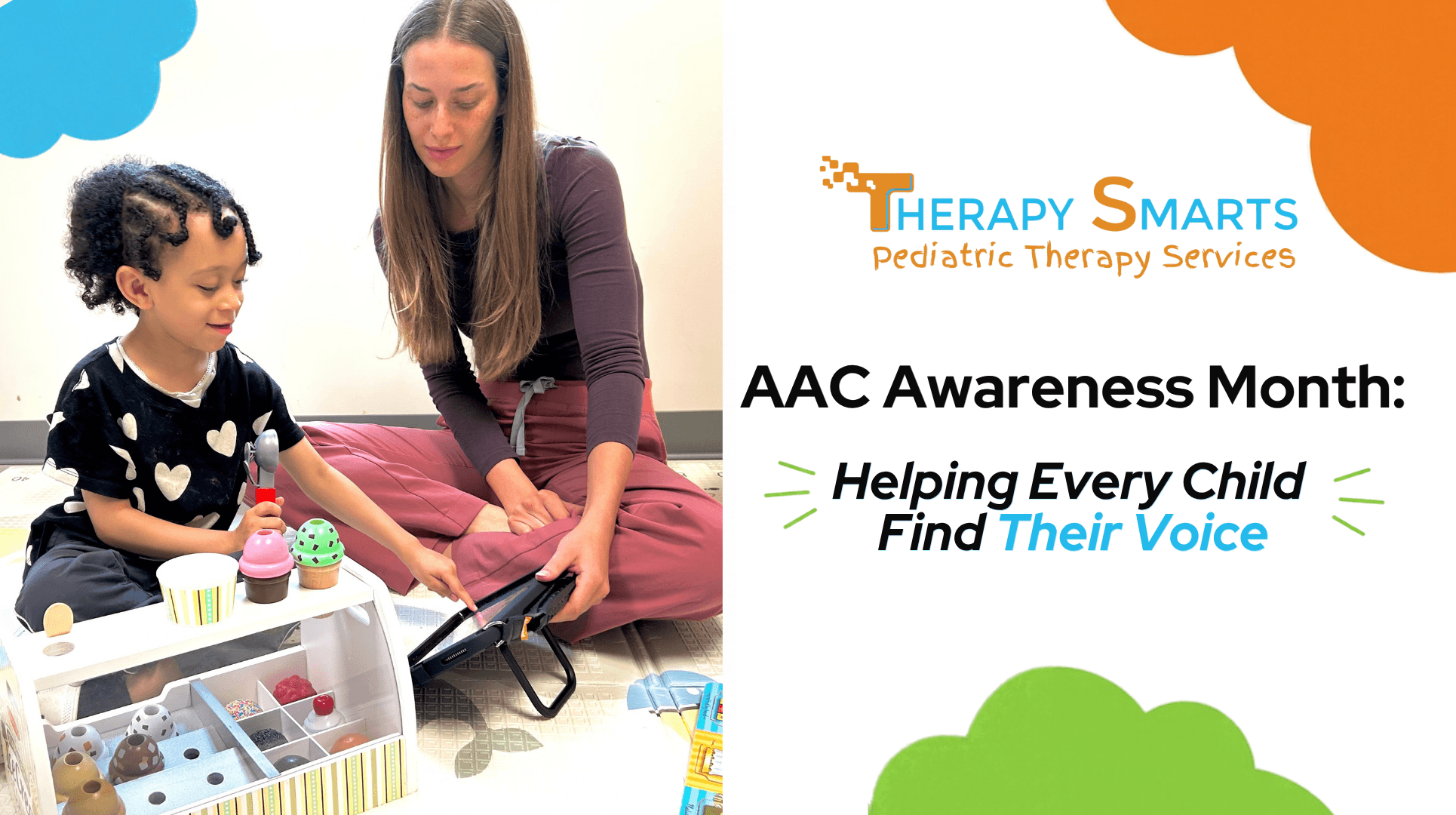
Every child deserves the opportunity to communicate their wants, needs, ideas, feelings, and personality. During AAC Awareness Month, Therapy Smarts is highlighting the important role Augmentative and Alternative Communication (AAC) can play in helping children connect with the world around them.
At Therapy Smarts, our pediatric therapy teams in Durham and Chapel Hill, North Carolina, work with children and families to find communication strategies that meet each child where they are. For some children, that may include an AAC device or another form of alternative communication.
What Is AAC?
AAC stands for Augmentative and Alternative Communication. It includes different methods and tools that support or supplement spoken communication.
AAC can range from simple, low-tech options to advanced speech-generating technology. Examples include:
Picture or symbol communication boards
Communication books
Gestures and signs
Tablet-based communication apps
Speech-generating devices
Eye-gaze or other access technologies
AAC is highly individualized. The right communication system depends on a child’s abilities, needs, preferences, motor skills, vision, and communication goals.
Who Can Benefit From AAC?
AAC may be helpful for children who have difficulty using speech to communicate consistently or effectively. This can include children with autism spectrum disorder, cerebral palsy, developmental delays, motor disorders, genetic conditions, childhood apraxia of speech, and other communication challenges.
Some children use AAC temporarily while developing other communication skills, while others may rely on AAC as a long-term or primary way to communicate. Most importantly, AAC gives children another way to express themselves.
How Therapy Smarts Uses AAC to Support Communication
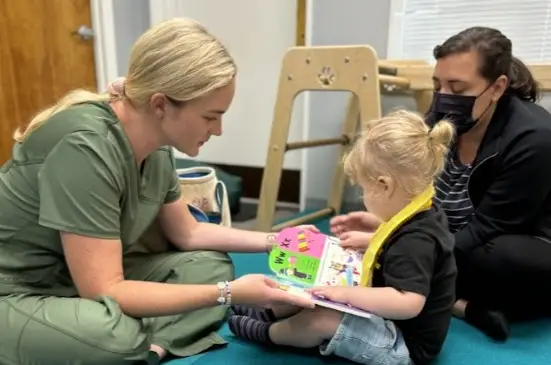
At Therapy Smarts, our Speech-Language Pathologists (SLPs) can incorporate AAC into therapy based on each child’s individual communication needs and goals.
Therapy may focus on helping a child learn how to use their AAC system to make requests, answer questions, express emotions, participate in conversations, make choices, comment on their environment, and advocate for themselves. But successful AAC use goes beyond the therapy room.
Our pediatric therapists can also work with parents, caregivers, teachers, and other members of a child’s care team to help create opportunities for communication throughout everyday routines. Whether a child is playing at home, participating in school, eating dinner with family, or spending time in the community, communication should be accessible.
AAC Does Not Take Away a Child’s Voice
One misconception families sometimes encounter is that using AAC will prevent a child from developing spoken language. AAC is not about replacing a child’s voice or limiting communication. It is about expanding access to communication. Communication is much bigger than spoken words.
A child’s voice can come through speech, pictures, symbols, gestures, signs, a communication device—or a combination of approaches. The goal is to give children reliable ways to communicate and participate as fully as possible in their everyday lives.
Communication Is a Team Effort
Because Therapy Smarts offers multiple pediatric services under one roof, our clinicians can collaborate across disciplines when appropriate.
In addition to Speech Therapy, Therapy Smarts provides Occupational Therapy, Physical Therapy, ABA Services, Mental Health Services, and Psychological Evaluations in Durham and Chapel Hill.
For a child using AAC, collaboration can be especially valuable. For example, an occupational therapist may help address fine-motor, sensory, positioning, or access needs that affect how a child interacts with a communication system, while a speech-language pathologist focuses on functional language and communication. The shared goal is simple: help the child communicate successfully and confidently.
Celebrating Communication During AAC Awareness Month
As Therapy Smarts celebrates 10 years of turning challenges into triumphs, we are proud to recognize the many different ways children communicate. A milestone may be a child’s first spoken word. It may also be the first time they use a symbol to request a favorite toy, use a device to tell a parent how they feel, greet a friend independently, or communicate “no” when they don’t want something. Those moments and so many others matter.
During AAC Awareness Month, our CEO and Founder, Avani Shah, M.Ed; CCC-SLP, encourages families, educators, healthcare professionals, and community members to remember one important message:
“Every child has something to say. Our job is to help make sure they have a way to say it.”
Does Your Child Need Communication Support?
If you have questions about your child’s speech, language, or communication development, the Therapy Smarts team is here to help. Therapy Smarts provides pediatric Speech Therapy, Occupational Therapy, Physical Therapy, ABA Services, Mental Health Services, and Psychological Evaluations at our Durham and Chapel Hill locations.
Call (919) 378-1340 to learn more about our services or schedule an evaluation.
Therapy Smarts — Turning Challenges Into Triumphs for 10 Years.
Blog approved by Avani Shah, M.Ed; CCC-SLP
ABOUT THERAPY SMARTS
Through play therapy, exploration of their environment, and joyful engagement- Therapy Smarts of Durham and Chapel Hill help improve your child’s communication, motor, behavior, & social skills. Click below to learn more about our services.
JOIN OUR TEAM
Are you a pediatric therapist looking to grow your career with a supportive, innovative team? Join Therapy Smarts of Durham and Chapel Hill — recently ranked #1,792 on Inc. Magazine’s 2025 Inc. 5000 list of fastest-growing companies in America!
We’re passionate about helping children thrive — and helping our team members do the same. Apply today!